Access Denied, Lessions Learned (1995-98)
by Joseph King
What follows was written in 1998 but was never published. As
if to prove the point of the article, nothing has changed at the UWRP
in the year that's transpired.
What follows is a story about failure. In
this case failure to gain safe access for pedestrians and cyclists to
a business park. It is hoped that by taking apart what happened in this
instance, as objectively as possible, such failures can be avoided in
the future.
Madison, Wisconsin is known generally as a city that is bike
friendly. The University of Wisconsin in Madison contributes to this
image by promoting cycling and maintaining it's own bike path system.
The University also extends into the community in many ways both
public and private. The University of Wisconsin Research Park (Research Park)
is a commercial venture by the University which leases space to
high-tech businesses.
Before becoming a park for high-tech business, the University used
the Research Park property as a research farm. The neighbors on the
eastern edge of the property became accustomed to farm plantings which
prohibited public access. When the University announced its intention
to turn this farm land into a business park, some of these neighbors
vigorously opposed it. To them this represented a loss of privacy and
security. The University worked with the neighborhood and the
Alderperson of the area to come to some understanding as to how that
land would be used. The result of this dialog produced a convenant
between the City of Madison and the University of Wisconsin. It was
also the first and perhaps most important error with regard to
facilitating human powered access to the Research Park.
They say that good fences make good neighbors. Although there may
be some desire by some to install a tall fence along the edge of the
park, this impulse has thus far been well suppressed. The result is a
park-like setting that is open to the adjacent neighborhood which many
enjoy. The neighbors on the eastern edge use the Research Park for
walks, sometimes with the dog, and riding bikes, especially with the
kids. Since it is a very quiet place much of the time and especially
on weekends, it makes a good place for kids to bike, sled, ski, and
play. Unfortunately, perhaps because it so quiet, teenagers sometimes
use the parking area near the eastern edge at night. While the
drinking and noise-making on Research Park property is not frequent,
it is enough to make the neighbors feel justified in opposing the
creation of the park. Other intrusions such as pedestrians cutting
through the neighbors yards combined with the fear that one day an
additional roadway entrance will be added to the park on the east,
further supports the view that access from the east should never be
allowed.
When employees and businesses located in the Research Park asked
about improving access to work from the quiet neighborhoods on its
eastern edge, their questions were deflected. Greg Hyer, Research Park
manager, told me once that it is too hilly. The owner of one company
was told that the Alderperson, then Sue Bauman, won't allow it. An
employee at another company was told that they were working on it but
that the business that is leasing the land from the University won't
allow it. At one time we were told that the person who designs the
sidewalks has studied the issue and that no additional sidewalks are
needed. Not until Scott Rose and myself collected signatures and
presented them to the University and the City of Madison did we begin
to get past this metaphorical stone wall.
In the years following the establishment of the park, the need for
improved access from the east had become increasingly clear. At least
two accidents with minor injuries occurred where cyclists leave the
grass of the Research Park and join the public sidewalk. Access from
the east in winter was placing cyclists on Mineral Point Road. I took
a bad fall on Mineral Point due a snow covered pot hole with traffic
on my heels. The unofficial access points were narrow in places and
had become rutted. Besides the emerging public safety issues, public
policy, and transportation considerations were raised. In a 1995
letter to the Research Park Dr. John Devereux, President of the
Genetics Computer Group, Inc., wrote, "we now have seven or eight
people who come to work regularly by bicycle and two or three more on
foot. They contribute to those of us who come by car by reducing
traffic congestion and demand for parking. [T]herefore, could we
please meet with the designer for the park's roads and sidewalks to
see what his concerns are about the problem. [The] Genetics Computer
Group would be willing to pay for some of the expenses." At that time
about 20 of the several hundred Research Park employees worked at the
Genetics Computer Group.
 |
|
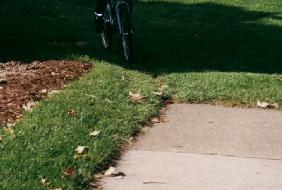
Pedestrians and cyclists pass within inches of a residents
garden because of large rocks or rougher conditions elsewhere.
A proposed access point would have connected cyclists to the
street end instead. |
|
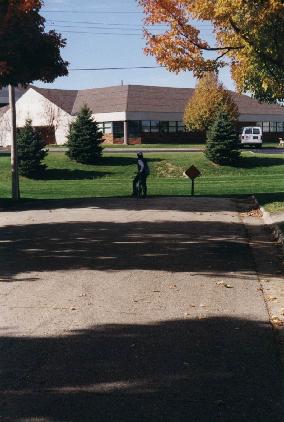 |
| We requested sidewalks from two street ends to provide safe
year-round access to the University Research Park for pedestrians and
cyclists. |
|
As employees' of businesses leasing property from the University
Research Park, we collected signatures in support of two pedestrian
connections from the east. One at Tocora Avenue and the other at
Manor Cross. We were convinced that these connections would provide
safe access to the Research Park for those walking and biking to work from the
neighborhoods east of the park. The connection at Tocora would
provide an alternative to Mineral Point Road for many and the
connection at Manor Cross would provide an alternative to Tokay Blvd.
There were two significant problems leaving the Research Park via Tokay on
bicycle. First, it required climbing and descending a significant hill
which can be troublesome in winter on a bike and even on foot.
Second, the boulevard median creates a barrier that puts the cyclist on the
sidewalk or the wrong side of the street at Segoe and Tokay. Since it
is a soft right turn from Segoe to Tokay, motorists take that corner
at a high rate of speed putting a "wrong-way" cyclist at greater risk.
We felt that a significant public safety issue had emerged that had
not been foreseen by the designers of the park.
It was now 1996 and our petition was finally drawing some attention
when the problems of the adjacent neighborhoods became the central
reason for not providing access. We were told that a convenant
existed that prohibited the park from ever providing any access from
the east so I had to look into it. The history and development of the
plans for the park make for some interesting reading. I wonder if
current residents know that the City of Madison requested that the
University begin developing the Research Park west of Whitney Way because if it
should fail, "the east half of the Rieder Farm [research farm] would
then be available for residential development abutting existing
residential uses," wrote George Austin, Director of Planning and
Development for the City of Madison. As part of this 1983
correspondence between George Austin and Wayne McGown, Assistant to
the Chancellor for the University of Wisconsin, Mr. McGown stated,
"[u]nder this arrangement, the one-hundred foot buffer zone [on the
eastern edge of the Research Park] would not have public access. An
alternative, which we have been willing to consider, would be to convey
a part of the one-hundred foot strip to the city for public walkway or
bikeway purposes..." The final result of this correspondence was the
creation of the aforementioned convenant which states that with
setbacks, "nothing is permitted except walks, turf and landscaping
unless such exception is specifically approved by the Design Review
Board." The setback on the eastern edge is an "area only for the
purpose of a landscaped buffer zone." Although posibly prohibitive,
the covenant can be amended. It became clear that a public relations
effort would be needed to gain the support of the adjacent
neighborhood. Toward this end Alderperson Sue Bauman agreed to
conduct a survey.
The results of the survey were said show
"strong opposition from residents," according to Alderperson Bauman.
Our analysis of the results, however, show that respondents were split
on the issue. Out of 58 households responding 33 supported the
connection while 23 opposed. Negative comments indicated that hard
feelings remained from the conversion of the farm to a business park
while some residents view the park as a neighborhood asset. One
resident wrote, "I'm in favor of path - I think it would possibly
eliminate short-cuts through my yard by strangers." Another went
further, "Since there are no sidewalks on Rushmore Lane, it's too
dangerous for our children to ride our bikes. The one place we do
allow them to ride is in the University Research Park..."
There were many negative comments to be sure. While these voice
understandable fears, past experience could not justify them.
Typically the fear relates back to a further loss of privacy and
security. Creating clearly designated connections to the Research Park could
help eliminate the trespassing problem that some neighbors are
currently experiencing. The path might attract adults walking or
biking to the nearby shops in the evening thus reducing the
attractiveness of the Research Park parking lots to teens. The survey
convinced me that with the cooperation of the UW and the City of
Madison these public relations obstacles should be overcome in the
interest of public safety. I was given the chance to present this
view to the Research Park Design Review Board and they agreed. In the fall of
1996 the board directed Ed Hopkins, Planner for the Research Park, to draw up
plans for the construction of sidewalks connecting the park to Tocora
Avenue and Manor Cross. The purpose of these plans would be to
further public discussion and education.
They say that silence is golden. If so, I must be rich because
nearly a year and a half after that meeting not a word was heard from
the Research Park regarding the plans for sidewalks. This is when I
again had a near-death experience on Mineral Point Road during my bike
ride home from work. Motivated by the will to live, I sent a nasty
email message to UWRP. A week later I was faxed a rough draft of some
plans to connect Manor Cross to the Research Park with a sidewalk.
More silence followed and in July, 1998 a phone call to Mr. Hopkins
went unreturned. I was beginning to think that nothing would ever
come of our efforts when a resident of Manor Cross confirmed my
suspicion.
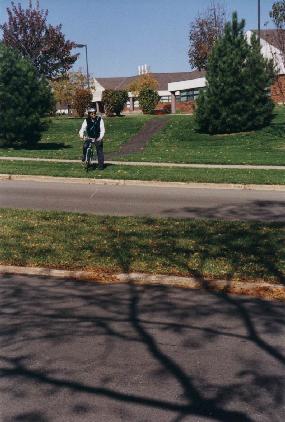 |
| An additional connection to Tokay Blvd. was built this
fall. There is no curb cut because it does not reach the curb. A
cyclist must either cross three curbs or travel against traffic on the
sidewalk or the street to head east. |
|
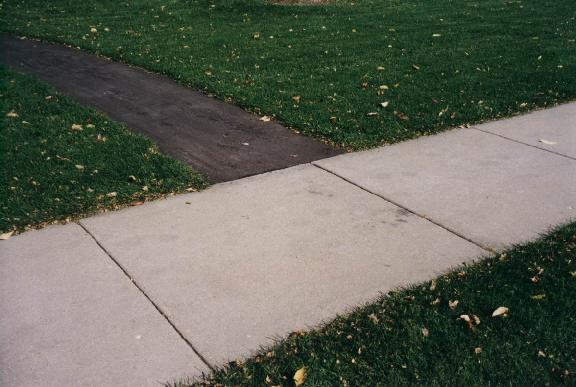 |
| The new connection to Tokay is not as wide as a normal
sidewalk. |
|
They say it's not over until the fat lady sings. Well, in this
case it was nearly over before I even found out about it. A work
associate and nearby resident of Manor Cross asked a co-worker to tell
me she won't be able to make the meeting tonight but see sent a letter
of support. I had no idea to which meeting she was referring. On a
hunch, I called Ed Hopkins and he informed me that the plans were
complete and he and Alderperson Gary Paulson were having a meeting
with the neighborhood tonight. I asked if I could come and he
agreed.
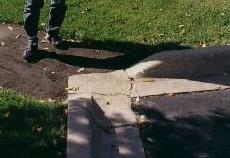 |
The curb cut entrance of the new
path to the park isn't wide enough
for a wheelchair nor the snow plows
used to clear the sidewalks in the
winter. |
Since we were given no warning or time to prepare, representation
at the meeting was singularly one-sided in opposition. The meeting
ended with Ed Hopkins deciding on the spot that plans to connect Manor
Cross to the Research Park will be scraped thereby avoiding any serious public
education effort. Plans for the Tocora connection were not even
created. Being unprepared and feeling as though this was orchestrated
to exclude my involvement, I did not protest. However, the Research Park
agreed to create an additional connection from the park to Tokay Blvd.
I did suggest that the new connection to Tokay should have a curb cut
and a cut through the median. He indicated that he would look into
it.
Access to the Research Park is slightly improved by the additional
connection to Tokay Boulevard. I see this too as a failure because the
adjacent neighborhood was not given a chance to act in their own best
interest. During that short meeting they did not see that proposed
connection to Manor Cross would have directed pedestrian and bike
traffic in the area away from peoples homes and gardens. They had no
chance to learn that additional bike traffic on their street, if any,
would promote slower auto traffic and better community (for example,
on Kendall Avenue during rush hour cars are often seen creeping along
behind cyclists until they reach a collector street). The
neighborhood remains largely unaware of the many ways that inviting
cyclists into your neighborhood promotes community and security.
Unfortunately for the people working at the University Research
Park, significant public safety issues remain and will likely remain
for the foreseeable future. Even though rutted, employees still cut
across the grass to connect to Manor Cross. The lack of curb and
median cuts for the new connection to Tokay places cyclists in a
"wrong-way" situation at a five point intersection. Snow removal
might be difficult because of the extremely narrow curb cut where the
path connects to the park resulting in icy conditions during the
winter months.
In conclusion, there are several lessons we can take home from
this experience:
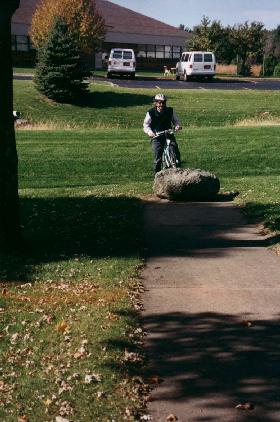 |
A Neighbor to the park expresses the view
that those of us that choose to walk and
bike to work are not welcome in their
neighborhood by placing a large rock on
the public sidewalk. |
|
- Initial plans for the park failed to consider that people will walk
and bike to work from neighborhoods adjacent to the park.
- Initial plans failed to consider that a business park with
landscaping can be an attractive place for nearby residents to
walk, exercise, and play.
- Advocates failed to get involved in the initial discussions
relating to the design of the park.
- Advocates (i.e. me) failed to insist that officials honor their
commitments in a timely fashion. Had I badgered the UWRP
constantly, plans may have been developed sooner. Presumably we
would have been aware of the neighborhood meeting in advance giving us
time to prepared the neighbors for the meeting with leaflets and
door-to-door educational efforts.
- The City of Madison failed to insist upon minimum standards for
pedestrian access and safety. The sidewalks in front of the buildings
don't even connect to the public sidewalk on Science Drive (where
sidewalks exist at all).
- Most political leaders are unwilling to lead constituents
toward a greater understanding of the issues by pointing out
unjustifiable fears. This, unfortunately, promotes insular attitudes
among residents.
During the years I spent working on this project I had always felt
that I was a member of two communities. The Research Park is
connected to the surrounding neighborhoods not by roads and sidewalks
but by people like me and my co-workers have who live there. I felt as
though I was being cast out of the community when neighbors to the
park expressed hostility to those who bike and walk to work. My image
of community in Madison was forever changed by this experience.